I watch Cornelia Hesse-Honegger working in
her apartment in Zurich and try to imagine what she sees through her
microscope. Beneath the lens is a tiny golden-green insect, one of the “leaf
bugs” she has been painting for more than 30 years. The binocular microscope
magnifies to 80X. The centimeter scale in the left eyepiece allows her to map
every detail of the animal’s body with precision.
Cornelia
collected this animal close to the Gundremmingen nuclear power plant in southern Germany. Like most of the insects she paints,
it is deformed. In this case, its abdomen is irregularly shaped, a little
crinkled on its right side. To me, even under the microscope the deformity is
all but imperceptible. But just think, she says, how such an anomaly must feel
if you are only 5 mm long!
What does
Cornelia see when she focuses so intently on this creature? She tells me that
when she’s outside, collecting in fields, at roadsides, and on the edges of
forests, she “loses herself in the animal.” At these moments, she says, she
feels “very connected, extremely connected,” feels a deep bond, as if, perhaps,
she herself had once been such a creature—a leaf bug—“and had a body
remembering.”
But her painting practice, as she explains
it, is almost the opposite of this. When she sits down with her microscope, she
no longer experiences the insect as coevolved being, but as form and color,
shape and texture, quantity and volume, plane and aspect. Her work becomes as
mechanical as possible. (“I want to be like a laser that goes from one square
centimeter to the next. I see it, I show it; I see it, I show it,” she tells
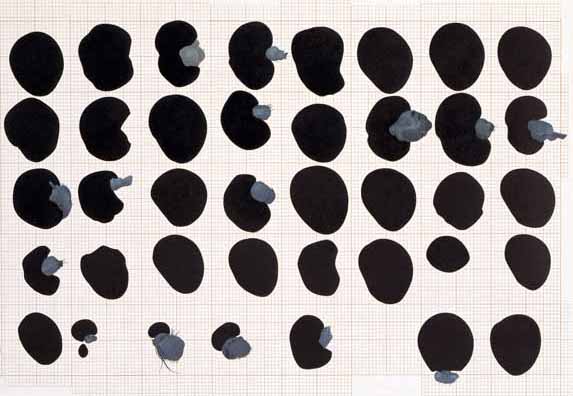
me.) At times, as in the painting on this page, she introduces a principle of
formal randomness, selecting specimens from her collection by chance and
abstracting a single structure which she repeatedly positions at designated
points on the graph paper, creating an image with no preconceived final
arrangement.
The painting shows a series of eyes from
fruit flies, Drosophila melanogaster,
that had been irradiated by geneticists at the Zoological Institute of the
University of Zurich. Radiation has left the eyes irregularly positioned on the
flies’ heads and, as a result, despite the orderliness of the arrangement, the
horizontal and vertical lines in the paintings are uneven. The flies’ eyes are
bizarre. Their size and shape vary dramatically. Several are sprouting wing
parts, aberrations that allow the researchers to investigate cell behavior—“like
someone who studies a train by systematically letting it derail,” as Cornelia
puts it. One fly, represented by empty space, has an eye missing entirely.
Cornelia painted this picture in 1987. But
she first drew mutated Drosophila twenty years earlier as a scientific illustrator at the Zurich Zoological
Institute. In a standard protocol, those flies had been fed food laced with
ethyl methane sulfonate. The resulting mutations fascinated her so much that she began painting the damaged
insects in her own time, experimenting with angle and color, even casting some
large heads as plastic sculpture, struggling to make sense of the disturbing
world she was being pulled into. At the Institute, her job was to draw the
varied appearance of the so-called “quasimodo” mutants. The animals were
crippled and pitifully monstrous, “chaotically” deformed. In preparation for
the illustrators, the inner organs of each fly’s head were dissolved with a
chemical agent that left the disturbed face as a mask. “The mutants were not to
leave me,” she wrote. And, indeed, from this point on, her life is shadowed by
the victims, actual and potential, of induced mutation….